The Myth of the Man at the Top: Nobody Has Ever Actually Been in Charge
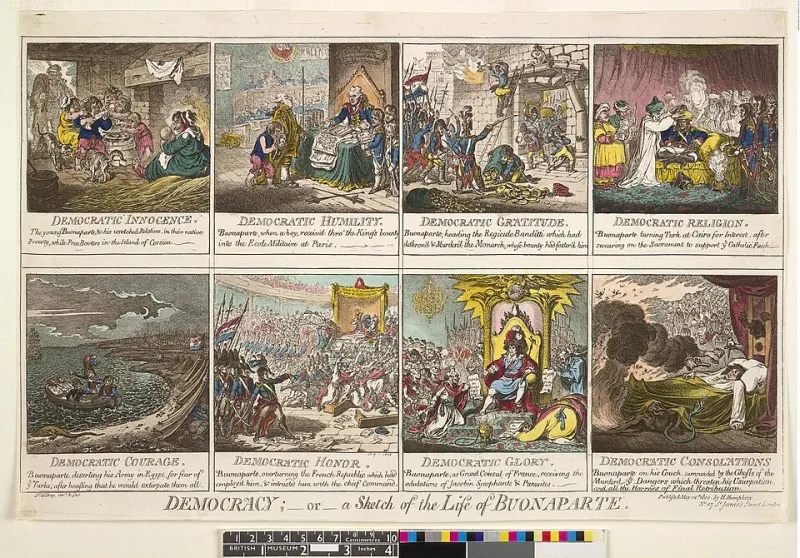
Photo: Print made by: James Gillray Published by: Hannah Humphrey, Public domain, via Wikimedia Commons
Ask an American who is responsible for the price of groceries, and they will name the president. Ask who is responsible for a company's collapse, and they will name the CEO. Ask who is responsible for a war, a recession, a school system's failure, and you will get a name — one name, a face, a person — because the human mind has a five-thousand-year-old habit it cannot break: it converts systems into sovereigns.
The uncomfortable finding of comparative history is that this habit has always been a misreading. No one has ever been in charge of anything, at least not in the way we mean it. And the modern media environment, which packages every institutional outcome as a personality story, has made the misreading worse.
The God-King's Empty Throne
Consider the pharaohs, the most extreme version of centralized authority human beings have ever constructed. The Egyptian king was not merely a ruler; he was a god, personally responsible for the flooding of the Nile, the rising of the sun, the maintenance of cosmic order. There is no clearer example of a civilization staking everything on the premise that someone is in charge.
And yet the day-to-day operation of Egypt ran through viziers, temple bureaucracies, provincial governors, and — above all — through the Nile itself, which no one controlled. When the floods failed in the late Old Kingdom, the god-king could not make the river rise. The result was the First Intermediate Period: the collapse of central authority precisely because the central authority had been assigned responsibilities it never had the power to discharge. The ideology of total command set the king up to absorb every failure the environment produced.
This is the trap, and it is structural. The more completely a society believes its leader controls outcomes, the more completely every outcome becomes the leader's fault — and the more brittle the whole arrangement becomes.
The Boardroom Pharaoh
The modern corporation inherited the theology without the divinity. The CEO is our secular god-king: celebrated on magazine covers when quarterly numbers rise, sacrificed to them when they fall. But anyone who has worked inside a large organization knows the reality. Power in a firm is distributed across middle managers who interpret directives, boards that constrain, regulators who preempt, markets that ignore, and information systems that filter what the top actually sees.
The academic literature has a name for this — the garbage can model of organizational choice, developed in the 1970s to describe how decisions in institutions emerge from loose couplings of problems, solutions, and chance rather than from anyone's deliberate command. Empirically, the evidence that CEOs drive firm performance is far weaker than the compensation suggests. We pay one person as though they steer the ship; in truth the ship is steered by currents, and the person at the helm mostly chooses which of the ship's own habits to express.
Why We Keep Buying It
The belief in the man at the top is not a media conspiracy; it is a cognitive default. Human beings evolved in small groups where a dominant individual genuinely could shape outcomes. Our pattern-matching machinery, applied to a nation of 330 million people or a firm of 200,000, produces a category error: it finds the most visible person and assigns them the causality of the whole system.
What is genuinely new is the industrial scale of the error. The modern news cycle — and the social media ecosystem layered on top of it — monetizes personality attribution. A structural explanation for inflation is a dry explainer; a photograph of the president at a gas pump is a story. Platforms reward the frame in which someone is in charge, because that frame generates outrage, and outrage generates engagement. The god-king has been resurrected by the recommendation algorithm.
The consequence is a politics of permanent, misdirected accountability. Voters punish and reward leaders for outcomes driven by monetary policy, global supply chains, demographic drift, and technological change — none of which any single officeholder controls. Leaders, understanding the game, respond by performing control rather than exercising it: executive orders as theater, announcements calibrated to the news cycle, symbols substituting for levers.
What Actually Moves
None of this means leadership is meaningless. It means the causality runs differently than we imagine. Leaders matter most at the margins — in crises where standard operating procedures fail, in the selection of priorities, in the tone they set for institutions that take their cues from the top. But the bulk of what happens in any large society happens through distributed processes that no one commands: prices, migrations, innovations, demographic shifts, the slow accumulation of institutional habit.
The cliodynamic record is blunt on this point. Civilizations have risen and fallen through impersonal forces — climate, fiscal structure, elite overproduction — that no ruler willed into being. The rulers who fared best were those who understood their actual, limited levers and used them; the ones who fared worst were those who believed their own publicity.
The demand for accountability is legitimate. The question is whether we aim it at the right target. Holding a president responsible for the price of eggs is like blaming the pharaoh for the Nile. The harder, less satisfying work is auditing the systems — the central bank's mandate, the zoning codes, the incentive structures of platforms — where the real levers sit, unglamorous and largely unstaffed by anyone whose face appears on television.
History's verdict is consistent: the fantasy of the man at the top is not merely inaccurate. It is dangerous, because it concentrates our scrutiny on the one place where it changes the least.