Opinion: The Culture War Is Ancient. What's Dangerous Is Believing It Isn't.

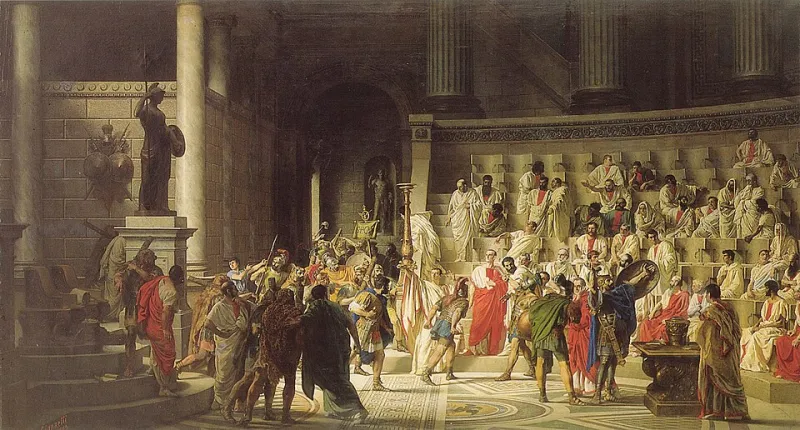
Photo: BeBo86, CC BY-SA 3.0, via Wikimedia Commons
Opinion: The Culture War Is Ancient. What's Dangerous Is Believing It Isn't.
Let me propose a thought experiment. Take any representative sample of today's American political commentary — the cable news monologues, the Substack manifestos, the congressional floor speeches — and strip out the proper nouns. Remove the specific contemporary references. Replace the names of the combatants and the particular symbols they are fighting over with placeholders.
What remains is a document that a historian of Rome's late Republic, of Reformation Germany, of Weimar's final years, would find entirely familiar. Not metaphorically familiar. Structurally, mechanically, almost procedurally familiar — the way a physician recognizes a disease presentation regardless of the patient's name.
This is not a comforting observation. But it is a more useful one than almost anything currently being published about American political culture, because it opens a question that the relentlessly presentist frame of contemporary commentary forecloses entirely: how did previous societies navigate comparable cycles, and what actually determined whether they came out the other side?
What a Culture War Actually Is
The term "culture war" is recent. The phenomenon is not.
What historians observe, repeatedly, across geographies and centuries, is a specific political dynamic that emerges when the existing hierarchy of social status becomes contested faster than the formal institutions of a society can process the contestation. The specific content of the conflict — which religious practices are orthodox, which sexual behaviors are acceptable, which historical figures deserve monuments, which linguistic conventions signal moral seriousness — is almost always secondary to the underlying structure.
The underlying structure is a status competition in which the primary currency is not wealth or formal power but demonstrated moral standing. Participants signal their position not through the accumulation of material resources but through the performance of correct belief and the denunciation of incorrect belief. The specific beliefs at issue are less important than the social function the performance serves: establishing, maintaining, or challenging one's position in a hierarchy that is being renegotiated.
Late Republican Rome's conflicts over mos maiorum — the ancestral customs that defined Roman identity — had this structure. The Reformation's wars over liturgical practice had this structure. Weimar's battles over cultural decadence and national identity had this structure. The specific symbols were different in each case. The dynamic was not.
The Exceptionalism Trap
American political culture has a well-documented tendency toward exceptionalism — the conviction that American experience is qualitatively different from the experience of other societies and therefore cannot be usefully analyzed through comparative or historical frameworks. This tendency is, in ordinary times, relatively harmless. In a period of genuine civilizational stress, it becomes a specific liability.
The contemporary American culture war is being experienced, by most of its participants on both sides, as something without meaningful precedent: a conflict so fundamental, so morally stark, so rooted in irreconcilable values that the normal tools of political accommodation cannot reach it. This experience is sincere. It is also, from the perspective of the historical record, essentially universal among participants in comparable episodes. The Romans experiencing the Social War, the Germans experiencing the Kulturkampf, the English experiencing the Civil War's religious dimensions — all believed themselves to be living through a uniquely unprecedented moral crisis.
The belief that one's own culture war is uniquely severe is not a feature of unusually severe culture wars. It is a feature of culture wars generally. It is produced by the same psychological mechanism — the in-group's moral stakes always feel more real and more urgent than an outside observer's — that produces the phenomenon in the first place.
This matters because the exceptionalism trap forecloses the most useful question available: what actually ended previous comparable episodes, and what were the conditions that made resolution possible?
How They Ended: The Uncomfortable Data
The historical record on culture war resolution is neither uniformly optimistic nor uniformly catastrophic, but it is consistent enough to be instructive.
The most common resolution mechanism is not persuasion. Participants in mature culture wars do not, as a rule, change their minds about the underlying values at stake. The historical record offers very few examples of a society arguing its way out of a status competition through the quality of its arguments. What it offers instead are several distinct resolution pathways, none of them particularly comfortable to contemplate.
The first is exhaustion. Societies that survive their culture wars at manageable cost typically do so because the intensity of the conflict eventually outstrips the appetite of the ordinary population for the personal costs of participation. The leadership class on both sides maintains its commitment indefinitely; the broader population gradually redirects its attention toward the more immediate demands of economic life, family, and local community. The conflict does not resolve — it loses its mass base and becomes a specialist activity. This is roughly what happened to the American culture wars of the 1960s and 1970s by the mid-1980s, though the current cycle shows fewer signs of following the same trajectory.
The second pathway is institutional capture, in which one side achieves sufficient control over the relevant status-conferring institutions — universities, media, religious bodies, professional associations — to make the performance of its preferred values the price of admission to respectable society. This resolves the visible conflict by suppressing the losing side's public expression, which is not the same as resolving the underlying tension. The suppressed grievances typically resurface, often in more virulent form, a generation later.
The third pathway — the one that Weimar Germany demonstrated and that the historical record associates with the worst outcomes — is escalation to a point where the conflict is resolved not by any of the participants' preferred mechanisms but by an external force that neither side wanted and both sides enabled.
 Photo: Weimar Germany, via images.surfacemag.com
The Specific American Risk
The United States is not Weimar Germany. This comparison, endlessly invoked and endlessly contested in contemporary political commentary, generates more heat than light precisely because it is deployed as a conclusion rather than as the beginning of a structural analysis.
 Photo: United States, via img1.etsystatic.com
The structurally relevant question is not whether America is Weimar. It is whether the specific conditions that made Weimar's worst outcome possible — an exhausted institutional center, a status competition that had delegitimized the established political class on both sides, and an economic crisis that made the costs of continued conflict feel lower than the costs of the available alternatives — are present in sufficient combination to move the American case toward the third pathway rather than the first or second.
The honest answer, from the historical record, is that these conditions are partially present and partially not. American institutions, while genuinely stressed, retain more structural resilience than Weimar's did at comparable points in its crisis cycle. The American economic situation, while generating real grievance, has not produced the kind of hyperinflationary collapse that made Weimar's population receptive to radical alternatives. The American military and law enforcement establishments have not, as of this writing, shown the institutional fractures that characterized the late Weimar period.
None of this is a guarantee. The historical record is not a prediction machine. It is a pattern library — and the patterns it contains suggest that the window for the first resolution pathway, exhaustion, remains open, while the conditions for the third pathway are not yet fully assembled.
What the Record Recommends
I am not offering optimism here. Optimism is not what the historical record supports, and it is not what the editorial mission of this publication is.
What the record supports is a specific reorientation of attention. The contemporary American culture war will not be resolved by better arguments, more compelling moral frameworks, or more sophisticated political messaging — these are the tools that participants in every comparable historical episode believed would work, and they have not worked in any of them. It will be resolved, if it is resolved at all, by the same mechanisms that have resolved comparable episodes: exhaustion, institutional capture, or catastrophe.
The only variable that historical actors have reliably influenced is the speed of the first pathway and the conditions under which the second pathway operates. Societies that have maintained functional institutional centers — imperfect, compromised, perpetually criticized from both sides, but operational — have generally managed to reach the exhaustion resolution before the escalation pathway became dominant.
The American conceit that this culture war is uniquely modern, uniquely irresolvable, and uniquely beyond the reach of historical comparison is not merely intellectually wrong. It is strategically counterproductive. It forecloses the only frame in which the available resolution mechanisms are visible.
Five thousand years of comparable episodes are on the record. The experiment has been run. Drawing conclusions from it is not pessimism. It is the minimum requirement for serious analysis.