Six Months That Lasted Centuries: The Mechanics of Emergency Power That Never Expires
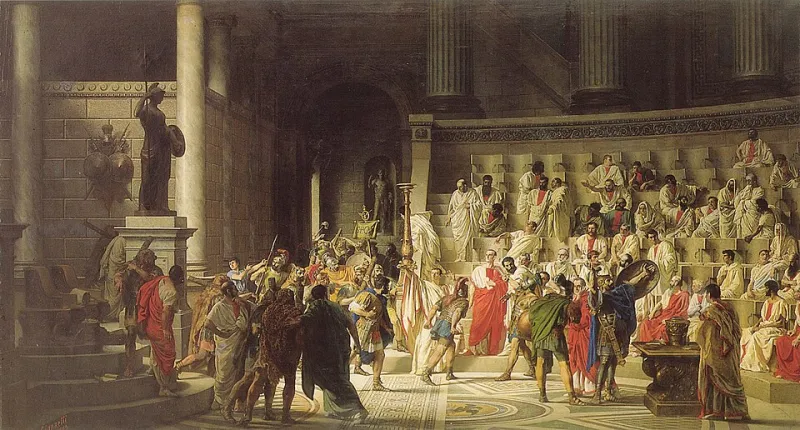
Photo: Raffaele Giannetti, CC0, via Wikimedia Commons
Every expansion of executive authority in a crisis begins with the same promise: this is temporary. The situation is extraordinary. Normal rules cannot govern abnormal circumstances. Once the emergency passes, the powers will return with it. This promise has been made, in recognizable form, by governments across five thousand years of recorded history. The frequency with which it has been kept is low enough that any serious student of the historical record should treat it as a structural feature of power rather than a failure of individual character.
The interesting question is not whether emergency powers tend to persist beyond their stated justification — they do, reliably, across cultures and centuries — but why the mechanism operates with such consistency, and what the architecture of the few genuine exceptions reveals about what prevention actually requires.
The Roman Dictatorship: A Design That Worked Until It Didn't
The Roman dictatorship deserves its place as the foundational case study in this literature not because it failed immediately, but because it worked for so long before it failed. The institution was established in the early Republic, around 501 BCE, with a design that reflected genuine sophistication about the problem of emergency power. The dictator held supreme authority — imperium unchecked by the normal mechanisms of collegial governance — but was bounded by two hard constraints: a six-month term limit and a specific triggering crisis whose resolution was expected to end the appointment.
For roughly four centuries, Roman statesmen honored this arrangement. Lucius Quinctius Cincinnatus, appointed dictator in 458 BCE to handle a military emergency, defeated the enemy within fifteen days and resigned before his term expired. He returned to his farm. The story became legendary precisely because resignation was the expected behavior — and because, even then, Romans understood that the temptation to retain power was real enough to require celebration when it was overcome.
 Photo: Lucius Quinctius Cincinnatus, via cdn.britannica.com
The institutional breakdown, when it came, was not sudden. It was a gradual erosion of the informal norms that had made the formal mechanism function. Sulla's dictatorship in 82 BCE was the first to abandon the six-month limit entirely; he held the position for approximately three years before resigning voluntarily. Caesar's dictatorship, appointed perpetuo in 44 BCE, formalized what Sulla had demonstrated: the term limit was a social convention, not a physical constraint, and social conventions do not survive contact with men who have the military force to ignore them.
The Republic did not end because Romans forgot what the dictatorship was for. It ended because the underlying conditions that had made the informal norms enforceable — rough military parity among the aristocracy, functional Senate authority, the absence of personal armies — had been eroded by the same crises that kept generating new emergency appointments. The emergency powers and the conditions that made them returnable were consuming each other.
Weimar and the Article 48 Problem
The Weimar Republic's Article 48 is the modern case most frequently cited in this context, and it earns its prominence. The provision allowed the Reich President to rule by emergency decree when public order was threatened — a power designed for genuine crises of short duration that became, under the pressures of the late Weimar period, the primary mechanism of governance. Between 1930 and 1932, emergency decrees were issued at a rate that effectively suspended parliamentary deliberation without formally abolishing the Reichstag.
 Photo: Weimar Republic, via cdn.britannica.com
What makes the Weimar case instructive beyond its catastrophic outcome is the specific path by which Article 48 normalized. It did not require a single dramatic seizure of power. It required a series of individually defensible decisions, each of which extended the emergency framework slightly beyond its previous application, each of which established a precedent that made the next extension slightly less remarkable. By the time the Reichstag fire decree of 1933 suspended civil liberties indefinitely, the political and legal culture had been so thoroughly conditioned to emergency governance that the formal transition to dictatorship was less a rupture than a clarification.
The lesson political scientists drew from Weimar — that emergency provisions require hard procedural limits rather than relying on the discretion of the officials who benefit from them — was applied, with varying rigor, to the constitutional designs of the postwar period. The German Basic Law of 1949 was specifically engineered to make Article 48-style governance structurally impossible. Whether those safeguards will hold under pressures their designers did not anticipate is a question that cannot be answered in advance.
The American Pattern: Wars That End, Powers That Don't
The United States has its own version of this history, less dramatic than Rome or Weimar but no less consistent with the underlying pattern. The executive branch expansions associated with major American wars have displayed a reliable asymmetry: powers acquired under wartime justification tend to contract after the war, but rarely to their pre-war baseline.
The surveillance architecture built under the post-September 11 Authorization for Use of Military Force has been the most extensively debated recent instance, but it follows a pattern visible in the War of 1812, the Civil War, both World Wars, and the Cold War. Each conflict generated emergency authorities — detention powers, surveillance capacities, classification systems, executive war-making prerogatives — that were justified by the specific emergency and retained, in modified form, after the emergency's formal conclusion. The Foreign Intelligence Surveillance Court, established in 1978 as a check on executive surveillance, had by the early twenty-first century approved the overwhelming majority of requests submitted to it — a ratio that raises legitimate questions about whether a check that never refuses has retained its checking function.
None of this requires bad faith on the part of the officials involved. The mechanism operates independently of intent. Officials who acquire authority during emergencies develop institutional dependencies on that authority. Bureaucracies built to exercise emergency powers have organizational interests in the continuation of those powers. Legal interpretations that expand executive authority in crisis tend to survive the crisis as precedent. The ratchet clicks forward and rarely clicks back, not because officials are unusually venal but because the incentive structure of institutional self-preservation operates regardless of the individuals within the institution.
Why Voluntary Relinquishment Is the Exception
Cincinnatus returned to his farm. George Washington resigned his commission and then, after two terms, the presidency. These cases are celebrated because they are exceptional, and they are exceptional because the structural pressures on power-holders all run in the opposite direction. An official who relinquishes emergency authority faces the political risk that the emergency will recur and he will be blamed for having disarmed the state. An official who retains it faces no equivalent structural penalty in the short term.
The historical cases in which emergency powers were successfully returned to normal tend to share certain features: robust institutional actors with independent authority and the will to use it, a political culture that treated retention of emergency powers as genuinely disreputable rather than merely technically questionable, and — critically — a return to the underlying conditions of political equilibrium that made normal governance viable. Where those conditions were absent, the promise of return was almost always unfulfilled.
The contemporary United States is not Rome in 49 BCE, and the differences matter. But the pattern documented across five thousand years of political history is not a pattern of exotic or distant civilizations. It is a pattern of human institutional behavior under consistent structural pressures — pressures that do not change because the century changes, or because the government in question considers itself a democracy, or because the officials involved are sincere in their stated intentions. The emergency that lasts forever rarely announces itself as such. It arrives as a reasonable precaution, extended one defensible decision at a time, until the precaution has become the permanent condition and no one can quite identify the moment the transformation became irreversible.