The Oath That Kills: How Personal Fealty Has Ended Every System That Required It
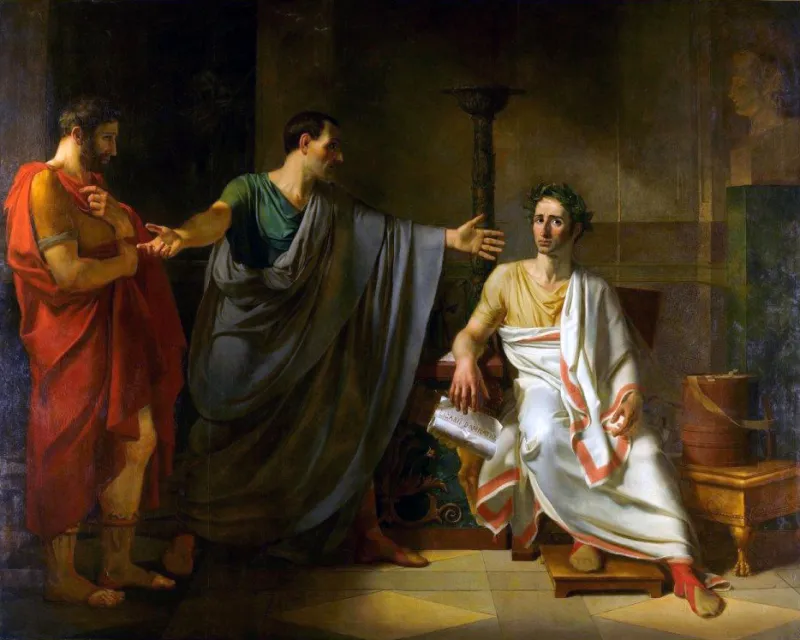
Photo: Abel de Pujol, Public domain, via Wikimedia Commons
There is a particular moment in the life of every declining institution that historians have learned to recognize. It does not announce itself with fanfare. It arrives quietly, dressed as a reasonable precaution: a new requirement that officials, soldiers, or subordinates affirm their personal loyalty not to the office, the constitution, or the law, but to the individual who currently holds power. The demand seems prudent. It feels like security. It is, in almost every recorded case, the beginning of the end.
The historical record on this point is not ambiguous. From the Roman legions to the medieval feudal compact to the loyalty oaths of twentieth-century autocracies, the transfer of allegiance from an institution to a person has functioned less as a stabilizing mechanism than as a slow-acting poison — one that kills the system first and the man who demanded the oath shortly thereafter.
The Roman Precedent No One Learned From
The Roman army was, for several centuries, one of the most institutionally durable military forces in recorded history. Its durability rested in part on a specific legal arrangement: soldiers swore the sacramentum to the Roman state, embodied in the Senate and the abstract authority of Rome itself. The general was an instrument of that authority, not its source.
The unraveling of this arrangement is one of the most consequential and least-heeded lessons in Western political history. As the Republic fractured in the first century BCE, successful commanders — Marius first, then Sulla, then Caesar — began recruiting soldiers whose personal economic survival depended entirely on the commander's political fortunes. The oath drifted. Soldiers who had nothing from the state and everything from their general swore accordingly. When Sulla marched on Rome in 88 BCE, he did not need to persuade his legions that they were betraying the Republic. He had already restructured their loyalties so that the Republic was an abstraction and he was a paycheck.
The pattern that followed is worth stating plainly: once legionary loyalty became personal rather than institutional, no Roman general could fully trust any other Roman general's army, no Senate could fully trust any general, and no emperor could fully trust the Praetorians he paid to protect him. The oath designed to guarantee obedience produced a political environment in which obedience was perpetually for sale. The Praetorian Guard, the ultimate expression of personalized military loyalty, murdered or deposed a remarkable number of the emperors it was sworn to protect. Personal fealty, it turns out, is renegotiated whenever a better offer arrives.
The Feudal Compact and Its Structural Failure
Medieval Europe built an entire political economy on the logic of personal loyalty, and its history reads as an extended demonstration of that logic's inadequacy. Feudal vassalage — the sworn personal bond between lord and vassal — was designed to create reliable webs of obligation in the absence of strong central institutions. In practice, it created a system in which every significant political actor was managing a portfolio of layered loyalties, each of which could conflict with every other.
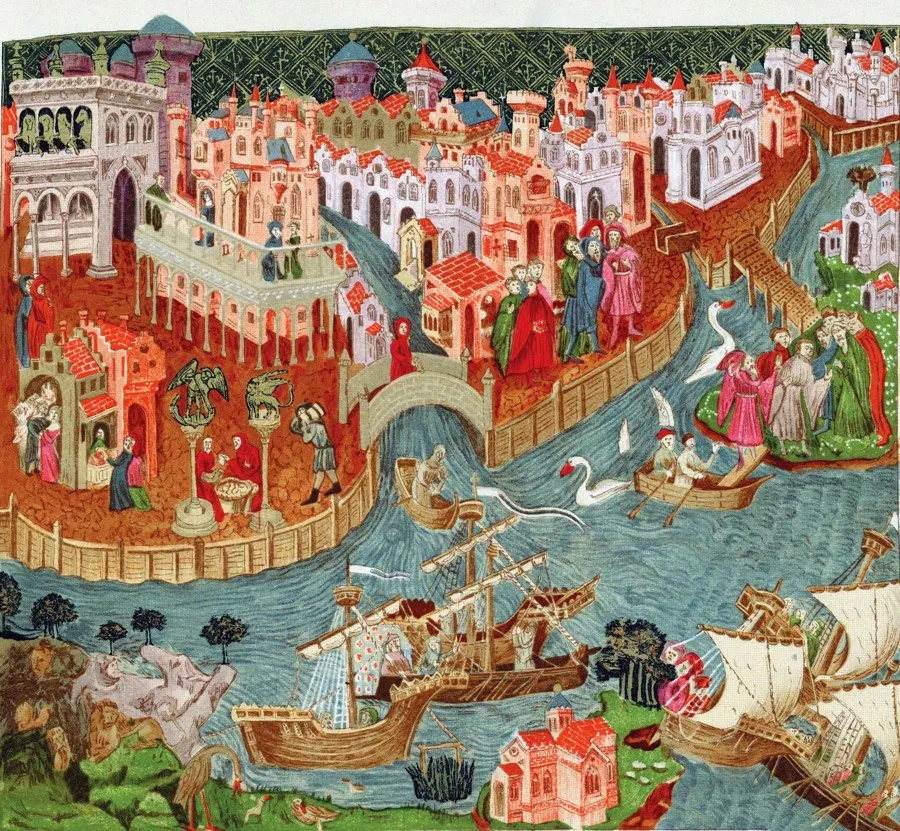 Photo: Medieval Europe, via kottke.org
The problem was not that medieval lords were unusually treacherous. The problem was structural. When loyalty is personal rather than institutional, it is bounded by the person's interests. A vassal who swore fealty to a count who swore fealty to a duke who swore fealty to a king had not created a stable hierarchy. He had created a chain of personal relationships, each of which was contingent on the calculation that honoring the oath remained more advantageous than breaking it. Medieval history is substantially a record of those calculations going wrong.
The monarchies that eventually consolidated power across Europe did so not by demanding more personal loyalty but by building institutions — courts, bureaucracies, standing armies paid by the crown rather than by nobles — that transferred allegiance back toward the system. The English common law tradition, which Americans inherited and which undergirds the constitutional framework the Founders constructed, was in significant part a technology for making the system more durable than any individual within it.
The Twentieth Century Runs the Experiment Again
The appeal of personal loyalty oaths has proven irresistible to regimes that have felt institutional constraints as threats rather than safeguards. The Nazi Führereid, introduced in 1934 after Hindenburg's death, is the most studied modern example: Wehrmacht officers swore personal allegiance to Hitler rather than to Germany or its constitution, a deliberate replacement of institutional obligation with personal fealty. The consequences for institutional resistance to criminal orders were, as the historical record documents exhaustively, catastrophic.
Less studied but equally instructive are the subtler versions of the same mechanism: the expectation in various authoritarian states that bureaucrats demonstrate personal devotion to the leader through public affirmation rituals, that military promotions flow from loyalty signaling rather than operational competence, that ambassadors and ministers understand their tenure to depend on personal favor rather than professional performance. Stalin's Soviet Union, Mao's China, and Saddam Hussein's Iraq all built elaborate systems of personalized loyalty — and all produced the same pathological result. Officials who owed everything to the leader's personal favor had powerful incentives to tell that leader what he wanted to hear. The information environment of every personalized-loyalty regime degrades, because the cost of honest reporting exceeds the cost of flattery.
This is the mechanism by which the oath destroys the man who demanded it. A leader whose subordinates are selected for personal fealty rather than competence, and who are rewarded for agreement rather than accuracy, eventually loses reliable contact with reality. He makes decisions based on information curated to please him, enforced by people selected to obey him, in an institutional environment stripped of the friction that might have caught his errors. The system dies first — hollowed out, its institutional functions replaced by personal calculation — and the man follows when the gap between his model of the world and the actual world becomes too wide to bridge.
What the Pattern Suggests About Institutional Pressure Today
The United States built its constitutional architecture with an explicit understanding of this history. The oath of office for federal officials — including the military oath that has remained structurally unchanged since 1789 — pledges allegiance to the Constitution, not to any individual. This was not an accident or an oversight. The Founders were students of Roman history in a way that most contemporary political actors are not, and they understood precisely what the transfer of military loyalty from the Senate to individual commanders had done to the Republic they admired.
The pressure to personalize institutional loyalty is not a uniquely contemporary phenomenon, and it is not uniquely American. It emerges wherever an individual within a system concludes that the system's constraints are obstacles rather than features, and wherever that individual has sufficient power to begin restructuring the incentives of subordinates accordingly. The historical record does not suggest that such pressure is unprecedented. It suggests, with considerable force, that it is recognizable — and that the societies that have preserved functional institutions across time are those that treated the first signs of loyalty personalization as a structural emergency rather than a manageable eccentricity.
The oath that binds soldiers and officials to a person rather than a principle has never, in five thousand years of recorded political history, produced the stability it promised. It has produced, with remarkable consistency, the conditions for the collapse of the very power it was meant to secure. That is not a coincidence. It is a mechanism. And mechanisms, unlike political promises, tend to operate the same way regardless of who is running them.